Rediscovering Button Lac
Can a wood finish be exciting? Mysterious? Even a little romantic?
Button lac was, for centuries, the primary processed form of shellac — and once you know its story, the stuff in the can starts to feel like a photocopy. It’s the original natural finish: shellac comes from a tiny lac insect that coats tree branches in resin, and people have been harvesting it for thousands of years — sealing royal letters with it, French-polishing furniture with it, pressing the first records with it.
And it earns the romance. As a finish, there’s nothing quite like it. It lays down smoothly, it’s reversible and repairable, and you can fix your goofs the same easy way you would with any shellac. It’s more water-resistant than dewaxed flake — thanks to the small amount of wax it keeps. It’s hard once cured, but not so brittle it can’t move with the wood. It carries wax, yet the cured film comes up as clear as any dewaxed grade, and it polishes to a mirror through patient French polishing. Done right, it lasts hundreds of years through the daily rigors of a life.

One of our customers ran his own test — several of our shellacs side by side, left to cure, then a hammer taken to each to see which resisted marring best. His button lac sample came through without a mark. He’s finished his custom guitars with nothing else since.
Made the old way

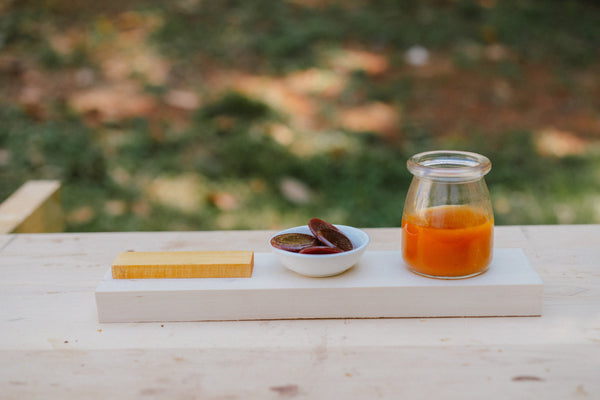
Button lac is shellac made the old way. Raw seedlac is melted over an open fire, squeezed by hand through a long cloth bag, and cooled into little amber buttons. No machines. No solvents. It takes real skill and patience to do well, and a handful of families in India still do it — the number who do it well getting smaller every year. Every button is shaped by the hand that pressed it.
It was also, before the mid-twentieth century, the main way shellac got dewaxed at all — the squeeze leaves some of the wax behind in the bag, and you’ll find mention of removing shellac’s wax in the old texts. Button lac keeps about two to three percent, down from the five or six in raw seedlac. Reduced, never stripped — and that remaining wax is much of what makes it special.
Beyond the bench, the same material has always done more: softened with heat into a taffy you can mold, cut into beads and bangles and ornaments, pressed into a hundred industrial uses. It is wildly versatile, and wildly old.
Why we nearly lost it
So why would something this good slip away? The answer to all your questions is money.
Button lac doesn’t scale. There is, to this day, no industrial way to make it — it’s inefficient, imprecise, and by the standards of a world that prizes automation and reproducibility, maybe just a little too wild and weird. When the factories wanted a finish they could spray and stack by the afternoon, button lac couldn’t keep up, and it quietly slipped out of the catalogs, then out of the conversation, until it survived only in the hands of people who refused to let it go. A thing that should not have been forgotten, very nearly was.
The part we can’t fully explain
Here’s the honest truth: we don’t entirely know why button lac is so good — at least not in tidy scientific terms. It’s a product of craft, not a spec sheet, shaped by generations of patient revision. It’s done this way because it’s done this way.
We do know the outline. Heat coaxes the resin to begin linking to itself — the same slow chemistry that hardens shellac as it ages — and the open wood fire, never the same twice, starts that process unevenly, in fits and layers. Coarse-filtered through a cloth bag, heated and reheated by feel, button lac is a kind of controlled chaos. The resin half-cures as it’s made and keeps hardening on your piece for months. Finishers swear it ends up tougher; luthiers swear it lets an instrument keep its voice instead of choking it. No one has run the lab study to settle it — but three centuries of workbenches are hard to argue with.
Maybe you don’t need the precise science to love it. It is what it is because it is made the way it is made: ancient, grounded, natural, and complex — a beautiful echo of antiquity, intricate enough that its full nature has been half-lost to time.
Not all buttons are the same

One catch: almost all the “button lac” sold today is quietly cut with rosin to bring the price down. It looks identical, dissolves identical — you can’t catch it by eye, and neither can a lab. Even craftsmen in India have told us pure button lac is hard to come by. The real thing is rare.
That’s why we work the whole chain. Our button lac comes through a family that has refined shellac for five generations, who hand clean seedlac to a few trusted cottage makers and take the buttons back with nothing added and no one in between. It’s the only way to vouch for what’s in the bag — so we can.
A couple of myths, while we’re here
“It takes weeks to cure.” Sort of. Like all shellac, button lac dries in minutes — the alcohol flashes off and you can recoat fast. But it isn’t fully cured for weeks, even months. Want to try the hammer test yourself? Let it sit. Then let it sit some more.
“You have to smash it with a sledgehammer to use it.” You don’t. Crushing any shellac just exposes more surface to the solvent so it dissolves faster — crushed ice versus a big cube. But if you’re like me, there are always twenty other things to do in the shop while it dissolves on its own. Patience and physics; no sledgehammer required.
If this is your kind of thing
Here’s what’s under all of it. Button lac doesn’t really make sense. It’s slow, made by hand, impossible to scale, and not even fully explained. It endures because some people — in cottages in India, at our bench, maybe at yours — decided certain things are worth doing the old way, for no better reason than that it’s the right way, and it’s the way it’s always been done.
If you’re nodding, you already know who you are. You’re the sort who’d true a board with a hand plane when a machine would be faster, because the hand way feels right. So are we. Welcome — pull up a bench.
Try it
You mix it like any shellac — dissolve the buttons in alcohol (here’s the cut chart) — with one fun choice: let the wax settle and pour off the clear, or stir it in and work it as-is. Both are traditional. Both work. Both cure into a lovely, clear finish.
Ours is 100% pure shellac with no added fillers. Nothing hidden. Nothing added.